DWC 201 · Mexico City, 1991

Mexico,
1991
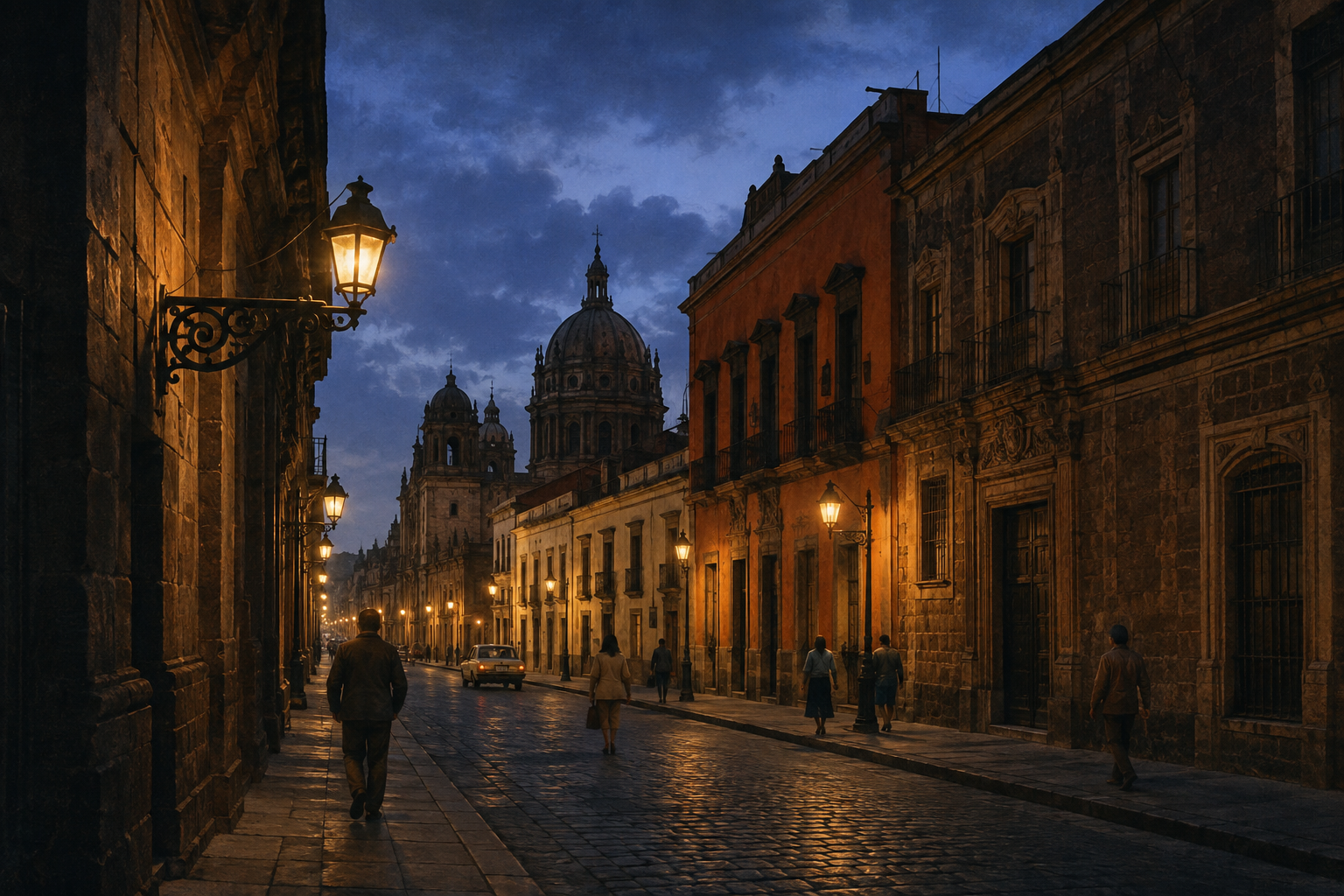
Artistic recreation of an evening street in Mexico City's historic center around 1991
Huntington's account
Huntington · paraphrased You want Mexico to stop being Latin American and become North American.
The adviser “Exactly! That's precisely what we are trying to do, but of course we could never say so publicly.”
“That's precisely what we are trying to do.”

Is a civilization something that gets recognized or something that gets made?

Who Is the “We”?
Common ground · August 31
Last time

What kind of thing is the West?

a placea lineagea conversationan institution

The same historical material can be connected by different stories.

Today

What can something called a civilization do?

Huntington turns a way of grouping history into a subject that can explain events.
Huntington's wager
clash.

In Huntington's account, civilizations...

clashrally kinaccept countriesdefend interests

Nation-states still make decisions, but civilizational identity is supposed to organize their behavior.

But a civilization has no...

cabinetvotechain of commandagreed spokesperson

The question is how a broad identity becomes a cause without being mistaken for a person.

Huntington, pp. 22–24
Classification is not yet explanation

Difference does not explain conflict by itself.

Cultural difference
→
What makes identity politically decisive?
→
Conflict becomes more likely
Choose one of Huntington's answers.

Then ask whether it explains stronger identity, conflict, or both.

Huntington, pp. 25–28 · use number keys 1–6

A useful theory must give good explanations.

Historical facts→ Fit→ Resist
Begin with what happened

Bosnia

The war included kin-country support, Croat–Bosniak fighting, NATO intervention, and the Srebrenica genocide.

Ukraine

Russia annexed Crimea in 2014 and launched its full-scale invasion of Ukraine in 2022.

Where Huntington's model fits

Bosnia

Serb, Croat, and Bosniak forces received important support from perceived cultural and religious kin.

Ukraine

His internal fault-line claim identifies a political and cultural division inside the country.

Where the model resists the evidence

Bosnia

Alliances and interventions did not sort neatly into civilizational blocs.

Ukraine

Huntington's expectation of little Russian–Ukrainian violence did not survive later events.

What result would make us revise the theory?

People can act on the categories used to predict them.

A category becomes politically consequential when institutions organize action around it.

↶ Policy can help produce the pattern the model expected.
Huntington's immediate advice

Protect the West's advantage

Hold Western states together, bring culturally similar countries closer, and preserve military superiority.

Huntington's longer view

Understand and coexist

Learn how other civilizations understand themselves, find common ground, and abandon the expectation of universal Westernization.

His conclusion asks for a richer understanding than his map may be able to provide.
Huntington, pp. 42–49

Said brings us back to the core issue just three weeks after September 11.

Bernard Lewis · 1990→Huntington · 1993→the “clash” revived after September 11
Which actors are hidden inside the noun?
Click a category aboveor press I / W
Edward W. Said, The Clash of Ignorance · The Nation, Oct. 4, 2001
Return to the first “we”

“The major contest in most modern cultures concerns the definition or interpretation of each culture.”

What is inherited?
Histories, languages, institutions, and political memories.
Who interprets it?
Governments, citizens, movements, and dissenting voices.
What can change?
Which affiliations matter, and what they are taken to mean.

Civilizations are assembled from inherited histories, but the meaning of that inheritance is continually revised through argument within them.

Inherited histories→Internal arguments→Revised collective identity
Said, Clash of Ignorance · Huntington, p. 43

The next “we” is already divided.

Pius IX · 1864
“The Roman Pontiff can and ought to reconcile himself...with progress, liberalism and modern civilization.”

This is proposition 80 of the Syllabus of Errors—a statement Pius IX condemns.

Edgeworth

Remembers the French Revolution as the destruction of religious and social order.

Grégoire

Argues that Christianity can serve liberty, equality, abolition, and republican citizenship.

If all three speak from within Catholicism, can “the West” have one voice?
Pius IX, Syllabus of Errors, prop. 80 · John T. McGreevy, Catholicism, chs. 1–3
← previous · → / space next · F full screen · N notes · G open subject · 1–6 mechanisms · I/W Said